
Football in Malaysia has evolved from colonial-era pastime into a unifying national passion, shaping identity and community across generations. Malaysian Football embodies a journey marked by legendary players, dramatic tournament victories, institutional challenges and a persistent drive to reclaim regional dominance. This guide explores the Malaysia national football team’s storied past, the structure of domestic leagues, iconic clubs, youth development frameworks and the vibrant stadium culture that defines the sport today. Fans aged 18+ are reminded to approach all football-related activities, including fantasy leagues and betting platforms, responsibly and in accordance with local regulations.
Overview of Malaysian Football
Malaysian Football operates as the nation’s most popular sport, governed by the Football Association of Malaysia (FAM), which oversees the Malaysia Super League, lower-tier divisions, cup tournaments and the national team structure. The modern ecosystem includes professional clubs, state-based franchises, private ownership models and academies focused on nurturing local talent. Attendance at Super League matches regularly exceeds 20,000 at flagship venues, while television viewership for key fixtures peaks above one million households. The sport’s appeal spans ethnic communities—Malay, Chinese, Indian and indigenous groups—united by shared pride in the Malayan Tigers, the nickname for the malaysia national football team.
Infrastructure improvements have accelerated since 2010, with new stadiums in Johor Bahru, Shah Alam and Kuala Lumpur meeting AFC standards. Financial investment from state governments and corporate sponsors has grown the league’s annual budget beyond MYR 100 million, enabling better player salaries, coaching education and youth programs. Regional rivalries animate the domestic calendar. The Johor–Selangor derby draws sell-out crowds and intense media coverage, while international friendlies against Thailand, Indonesia and Singapore generate patriotic fervour, reflecting Malaysia’s aspiration to match its neighbours’ FIFA rankings and tournament success.
History and Development of Football in Malaysia
Football arrived in British Malaya during the 1880s, introduced by colonial administrators and military personnel. The first recorded match took place in 1892 on a padang in Kuala Lumpur. By 1905, the Malaya Football Association was established, formalizing rules and organizing inter-state competitions among Penang, Selangor, Perak and Negeri Sembilan. The Malaysia Cup, inaugurated in 1921, became the premier knockout tournament, contested by state teams and Singapore.
Independence in 1957 catalyzed national identity building, and the newly formed malaysia football team entered international competition. The 1960s and 1970s marked the golden era of Malaysian Football.

Mokhtar Dahari, a prolific striker from Selangor, scored 125 goals in 142 international appearances between 1972 and 1985, earning the nickname “Supermokh.” Defender Soh Chin Aun captained Malaysia to consecutive Malaysia Cup victories and pivotal wins in the Merdeka Tournament. In 1972, Malaysia qualified for the Munich Olympics football tournament, the first Southeast Asian nation to do so, and reached the quarter-finals of the 1980 Moscow Olympics.
The 1980s witnessed Malaysia’s regional dominance. The malaysia national football team won the Southeast Asian Games gold medal in 1977, 1979, 1989 and 1991, and claimed four Merdeka Tournament titles in the same period. National pride peaked in 1980 when 80,000 fans packed Stadium Merdeka to watch Malaysia defeat South Korea 2–1 in an Olympic qualifier, a result celebrated as a defining moment in Malaysian sporting history.
The 1990s brought scandal and decline. In 1994, allegations of match-fixing and corruption within the FAM led to a government inquiry, tarnishing reputations of officials and players. Public trust eroded, attendance dropped, and corporate sponsors withdrew. The FAM restructured governance, introduced stricter referee oversight and banned implicated officials, but the damage persisted for a decade.
Revival began in the 2000s. Malaysia hosted the ASEAN Football Federation Championship in 2010 and reached the final, losing narrowly to Indonesia on aggregate. The emergence of Johor Darul Ta’zim (JDT) as a privately owned, professionally run club from 2013 onward injected new standards: state-of-the-art training facilities, foreign coaching expertise and systematic youth academies. JDT’s dominance—nine consecutive Super League titles from 2014 to 2023—raised the competitive bar and demonstrated the impact of sustained investment in Malaysian Football infrastructure.
Malaysia Super League and Domestic Competitions
The Malaysia Super League, founded in 2004, sits atop the domestic pyramid as the country’s top-flight professional competition. Twelve teams compete annually in a double round-robin format, totaling 22 matchdays from February to July. Points determine champions, with relegation for the bottom two clubs to the Malaysia Premier League. Total attendance for the 2023 season exceeded 1.2 million, averaging 9,000 per match, though flagship clubs like JDT and Selangor draw over 25,000 for home fixtures.
Prize money for the 2024 Super League champion stands at MYR 500,000, with runner-up receiving MYR 300,000. Television rights are managed by Astro and RTM, generating approximately MYR 30 million annually. Foreign player quotas allow five non-Malaysians per squad, with one ASEAN player exempt from the cap, encouraging regional talent circulation while protecting development opportunities for local players.
The Malaysia FA Cup and Malaysia Cup run concurrently with league fixtures. The FA Cup, a knockout tournament open to all FAM-affiliated clubs including amateur teams, crowns a winner in May after six rounds. The Malaysia Cup features group stages in August followed by knockout rounds, culminating in a two-leg final in October. Winning both the Super League and Malaysia Cup in a single season—the domestic double—remains a rare achievement, last accomplished by JDT in 2019 and 2022.
Major Football Clubs in Malaysia
Johor Darul Ta’zim dominates modern Malaysian Football. Founded in 1972 and rebranded in 2013 under the ownership of Tunku Ismail Sultan Ibrahim, Crown Prince of Johor, JDT operates with a budget exceeding MYR 80 million. The club has won nine consecutive Super League titles (2014–2023), five Malaysia Cup trophies and two FA Cups. JDT’s Sultan Ibrahim Stadium features hybrid turf and VAR-enabled broadcast facilities, setting a benchmark for Malaysian club infrastructure.
Selangor FC, based in Shah Alam and founded in 1936, holds the record for Malaysia Cup victories with 33 titles. The club’s red-and-yellow crest and “Red Giants” nickname evoke a storied past that includes the golden-era triumphs of Mokhtar Dahari and Soh Chin Aun. Average home attendance hovers around 18,000, with derby matches drawing over 40,000. Selangor finished second in the 2023 Super League, trailing JDT by seven points, but claimed the FA Cup in a penalty-shootout final.
Kedah Darul Aman FC, representing the northern state of Kedah, has won five Super League titles and eight Malaysia Cup crowns. The club’s Darulaman Stadium, renovated in 2017 with a 32,000 capacity, hosted the 2023 AFF Championship group-stage matches. Kedah’s academy produces consistent youth talent, with several graduates earning national-team call-ups.
Pahang FA, Perak FC and Terengganu FC round out the traditional powerhouses. Pahang won back-to-back Super League titles in 2013–2014. Perak’s stadium in Ipoh draws passionate support from a fanbase that recalls the club’s 1960s–1970s dominance. Terengganu, backed by state-oil revenue, claimed the 2023 Malaysia Cup, defeating JDT in a thrilling final.
The Malaysia National Football Team
The Malaysia national football team, nicknamed the Malayan Tigers, competes in AFC and AFF tournaments under FAM governance. Malaysia’s FIFA ranking fluctuated between 130th and 160th in the past decade. The team’s all-time record includes 299 wins, 187 draws and 421 losses from 907 matches played between 1957 and 2024, with Mokhtar Dahari’s 125 goals standing as the top scorer across all eras.
Home matches take place at Bukit Jalil National Stadium, an 87,000-capacity venue in Kuala Lumpur. Typical attendance for World Cup qualifiers averages 35,000, rising to 80,000 for high-stakes fixtures. The national team’s traditional colours—yellow shirts, black shorts—echo the royal tiger symbolism and evoke unity across Malaysia’s diverse population.
The golden era (1970s–1980s) saw Malaysia qualify for two Olympic football tournaments—Munich 1972 and Moscow 1980—and dominate the Merdeka Tournament. The malaysia football team won the SEA Games gold medal four times and reached the AFC Asian Cup finals twice. Key victories include a 2–0 win over South Korea in 1980 and a 3–0 demolition of Indonesia in the 1989 SEA Games gold-medal match.
Recent campaigns show progress. Malaysia finished third in the 2021 AFF Championship, defeating Thailand in the group stage before losing to Indonesia in the semi-final. FAM appointed Kim Pan-gon, a South Korean tactician, as head coach in 2022, tasked with implementing high-press tactics and integrating JDT’s title-winning core into the national setup.
Popular Football Players and Local Talents
Mokhtar Dahari remains Malaysian Football’s greatest icon. Born in Setapak, Kuala Lumpur, in 1953, Mokhtar debuted for Selangor at age 18 and for Malaysia a year later. His 125 international goals across 142 matches set a record unbroken after four decades. Mokhtar’s pace, finishing and aerial ability earned comparisons to European strikers. Tragically, he passed away in 1991 at age 37, but his legacy endures through the Mokhtar Dahari Stadium in Cheras and annual memorial matches.
Soh Chin Aun, born in Penang in 1950, captained the malaysia football team during its golden era. A commanding centre-back, Soh played 252 matches for Selangor and earned 219 international caps, leading Malaysia to four SEA Games gold medals and two Olympic qualifications. Soh retired in 1984 and later served as FAM technical director, mentoring coaches and shaping youth-development frameworks.
Modern talents include Safawi Rasid, JDT’s attacking midfielder, who holds the record for most assists in a single Super League season (18 in 2019). Safawi remains central to both JDT’s domestic dominance and the national team’s creative play. Luqman Hakim Shamsudin, a forward born in 2001, joined Belgian club KV Kortrijk on a professional contract in 2023, signaling a new generation of Malaysian players seeking European opportunities.
Youth Academies and Player Development
Youth development in Malaysian Football relies on club academies, state football associations and FAM’s National Football Development Program. JDT’s academy, established in 2014, operates as the benchmark: residential facilities accommodate 120 players aged 13 to 19, who receive daily coaching from AFC-licensed instructors, academic tutoring and sports-science support. JDT’s youth teams compete in the President’s Cup and Malaysia Youth League, regularly finishing in the top two.
FAM’s National Football Development Program, launched in 2009, identifies talent through regional scouting camps and district competitions. Selected players aged 12 to 16 attend centralised training at the National Football Development Centre in Kuala Lumpur, combining school attendance with afternoon training sessions. The program emphasizes technical skills over physical development.
School football remains foundational. The Ministry of Education’s Inter-School Football Championship involves over 3,000 schools nationwide. District tournaments feed state finals, with champions advancing to national playoffs. Scouts from Super League clubs attend finals to recruit promising teenagers, offering academy trials and scholarship pathways.
Football Stadiums and Fan Culture
Malaysian Football’s stadiums blend colonial-era relics with modern multipurpose arenas. Bukit Jalil National Stadium, completed in 1998 for the Commonwealth Games, seats 87,000 and hosts national-team fixtures, Malaysia Cup finals and major concerts. Renovation in 2017 added LED screens, Wi-Fi coverage and upgraded hospitality suites.
Sultan Ibrahim Stadium in Johor Bahru, JDT’s home, opened in 2020 with a 40,000 capacity and represents the future of Malaysian club infrastructure.
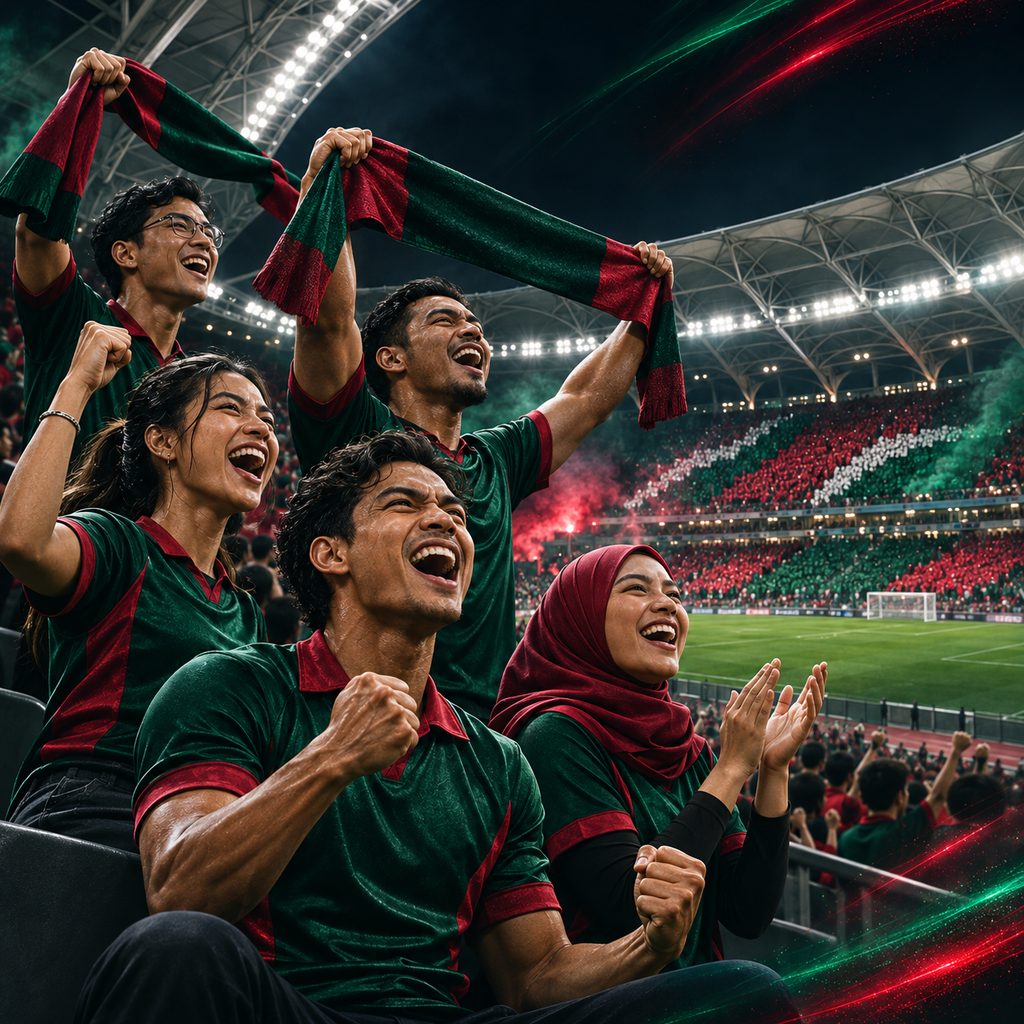
The “Southern Tigers” fanbase occupies the vocal south stand, deploying tifos, coordinated chants and smoke displays that mirror European ultra culture. The atmosphere ranks among Asia’s most intense.
Fan culture in Malaysian Football is family-oriented yet passionate. Supporters arrive hours early, purchasing jerseys, scarves and snacks from vendors outside grounds. Chants blend Malay, English and regional languages, with drums, horns and flags animating the stands. Derby matches escalate intensity, occasionally resulting in crowd trouble that prompts FAM fines and stadium bans.
Ticketing remains affordable: Super League matches cost MYR 15 for standing sections and MYR 50 for premium seats, keeping the sport accessible to working-class families. Season tickets for JDT and Selangor average MYR 400, with youth and senior discounts.
Malaysia in Regional and International Competitions
Malaysia’s regional record centres on the AFF Championship, Southeast Asia’s premier tournament. The malaysia national football team won the inaugural 1996 edition, defeating Vietnam 1–0 in the final, and reached the 2010 final. Recent campaigns show inconsistency: third place in 2021, group-stage exit in 2022. The 2024 AFF Championship represents a critical test under coach Kim Pan-gon.
SEA Games football remains a pride point. Malaysia captured gold in 1977, 1979, 1989 and 1991, with the 1989 triumph particularly celebrated after a 3–0 final victory over Indonesia before 80,000 fans in Kuala Lumpur. The 2023 SEA Games in Cambodia saw Malaysia exit in the group stage, prompting FAM to overhaul the under-23 program.
AFC Asian Cup participation is sporadic. Malaysia qualified for the 1972, 1976, 1980 and 2007 editions, reaching the quarter-finals in 1972 and 1976. A 42-year absence ended in 2019 when the malaysia football team qualified for the UAE finals, though group-stage defeats highlighted the gap to continental powers.
World Cup dreams remain distant. Malaysia never advanced beyond the second round of Asian qualifiers. The expanded 48-team 2026 World Cup allocates eight Asian slots, raising hopes, but Malaysia’s FIFA ranking of 138th places the nation outside the top 20 AFC teams.
The Future of Football in Malaysia
Malaysian Football’s trajectory hinges on sustained investment, governance reform and competitive realism. The FAM’s Vision 2030 document outlines three pillars: elite-team success, domestic league growth and grassroots expansion. Achieving these requires political will, private-sector partnership and cultural shifts away from short-term results pressure.
JDT’s model demonstrates scalable success. The club’s professionalism—transparent finances, meritocratic hiring, data-driven scouting—contrasts with state-run clubs vulnerable to political interference. FAM encourages privatization, yet only four of twelve Super League clubs operate as private entities.
Youth development faces structural challenges. While JDT and Selangor invest millions, smaller clubs lack resources for academies. The FAM’s proposal for regional training hubs aims to democratize access, but implementation requires MYR 200 million in capital and operational funding.
Women’s football holds untapped potential. The Malaysia Women’s Super League’s expansion to twelve teams by 2026, increased prize money to MYR 200,000 and broadcast partnerships signal commitment. The 2027 Women’s Asian Cup, if Malaysia qualifies, would accelerate visibility and investment.
FAQ
What is the Malaysia national football team’s nickname?
The malaysia national football team is nicknamed the Malayan Tigers, reflecting strength, agility and national pride. The name originated in the 1960s and remains the official moniker used by FAM and supporters. Traditional team colours are yellow shirts and black shorts, echoing the tiger’s stripes and Malaysia’s royal symbolism.
Who is the top scorer in Malaysian Football history?
Mokhtar Dahari holds the all-time record with 125 goals in 142 international matches for the malaysia football team between 1972 and 1985. His domestic tally for Selangor exceeded 250 goals, cementing his status as the greatest Malaysian footballer. Mokhtar passed away in 1991, but his legacy endures through memorials and annual tributes.
How many teams compete in the Malaysia Super League?
Twelve teams compete in the Malaysia Super League each season, playing a double round-robin format over 22 matchdays from February to July. The bottom two clubs face relegation to the Malaysia Premier League, while the champion and runner-up qualify for AFC club competitions. JDT has won nine consecutive titles from 2014 to 2023.
Has Malaysia ever qualified for the FIFA World Cup?
No, the malaysia football team has never qualified for the FIFA World Cup finals. Malaysia’s best attempt came in the 1980 qualifiers, reaching the second round before elimination. The expanded 2026 World Cup with eight Asian slots offers renewed hope, but Malaysia’s FIFA ranking of 138th places significant qualification challenges ahead.
What was the 1990s scandal in Malaysian Football?
The 1990s scandal involved match-fixing and corruption allegations that emerged in 1994, implicating officials, referees and players. A government inquiry led to lifetime bans, resignations and erosion of public trust. On-field performance declined sharply, with Malaysia failing to qualify for major tournaments until 2007. FAM restructured governance and introduced oversight mechanisms to restore credibility.
Which stadium hosts Malaysia national team home matches?
Bukit Jalil National Stadium in Kuala Lumpur, with an 87,000 capacity, serves as the primary home venue for the malaysia national football team. The stadium opened in 1998 for the Commonwealth Games and underwent renovations in 2017. Typical attendance for World Cup qualifiers averages 35,000, rising to 80,000 for high-stakes fixtures against regional rivals.
What is JDT’s role in modern Malaysian Football?
Johor Darul Ta’zim operates as Malaysia’s dominant club, winning nine consecutive Super League titles from 2014 to 2023. The club’s MYR 80 million annual budget, state-of-the-art facilities and professional management set standards for Malaysian Football. JDT’s youth academy and AFC Champions League participation raise the competitive bar domestically and regionally.
All football-related activities, including fantasy leagues and betting platforms, are subject to local regulations and should be approached responsibly by individuals aged 18 and above.